Awesome Evidence for Morality
Evidence for objective morality is findable.

In a previous article, I argued that Pascal-Wager-style reasoning works for moral uncertainty: if objective morality might exist, the best move is to stay morally uncertain and keep the search open, rather than reject moral realism and risk being immoral.
Read the article here:

At the Global Challenges Project workshop in Oxford, I got to 1-1 with many brilliant people, five or so of whom I got to run the argument past. It was convincing (to varying degrees). Almost everyone raised the same objection, though:
“What if I think objective morality doesn’t exist?”
That was my intuition too, for a long time. And if you’re certain there’s no such thing, the whole wager collapses: there’s nothing to be uncertain about, nothing to search for, no reason to update (or even hold) moral beliefs.
So here’s a rebuttal. To reject moral uncertainty, you have to believe there could never be any evidence for objective morality. The easiest way to refute a “never” claim is by using a counterexample. So here are a few.
The Awesome Evidence Argument
A while back I read Amos Wollen’s “Joe Folley tries to escape Islam; fails” which lays out the Awesome Evidence Argument.
The original target was a claim about cosmic fine-tuning (copy-pasted from Amos’s article):
“Fine-tuning isn’t any evidence for theism at all—in fact, no epistemically possible way that the initial conditions of the universe could be set up could ever be any evidence for God’s existence.”
Here’s the counterexample from philosopher Philip Goff (again from Amos):
Suppose we discovered the Quran was written in the Big Bang. What do I mean by that? I’m imagining physicists trace back the origins of the universe a little earlier, and identify some highly structured state that they were confident was the initial state of the universe. Of course, we can’t directly observe this first moment, but let’s just pretend all the evidence points to state S being the first state of our universe. As scientists study the rich structure of S, they are flabbergasted that the verses of the Quran, in Arabic, are to be found there, from start to finish. Call this the “Awesome Evidence.”
Now swap Islam for objective morality. Imagine we point a telescope at some far-off galaxy and find "KANT IS RIGHT ABOUT EVERYTHING" written in stars, in clean sans-serif and at a resolution of 1,000 stars per degree. That would make Kantian ethics seem more likely to be true.
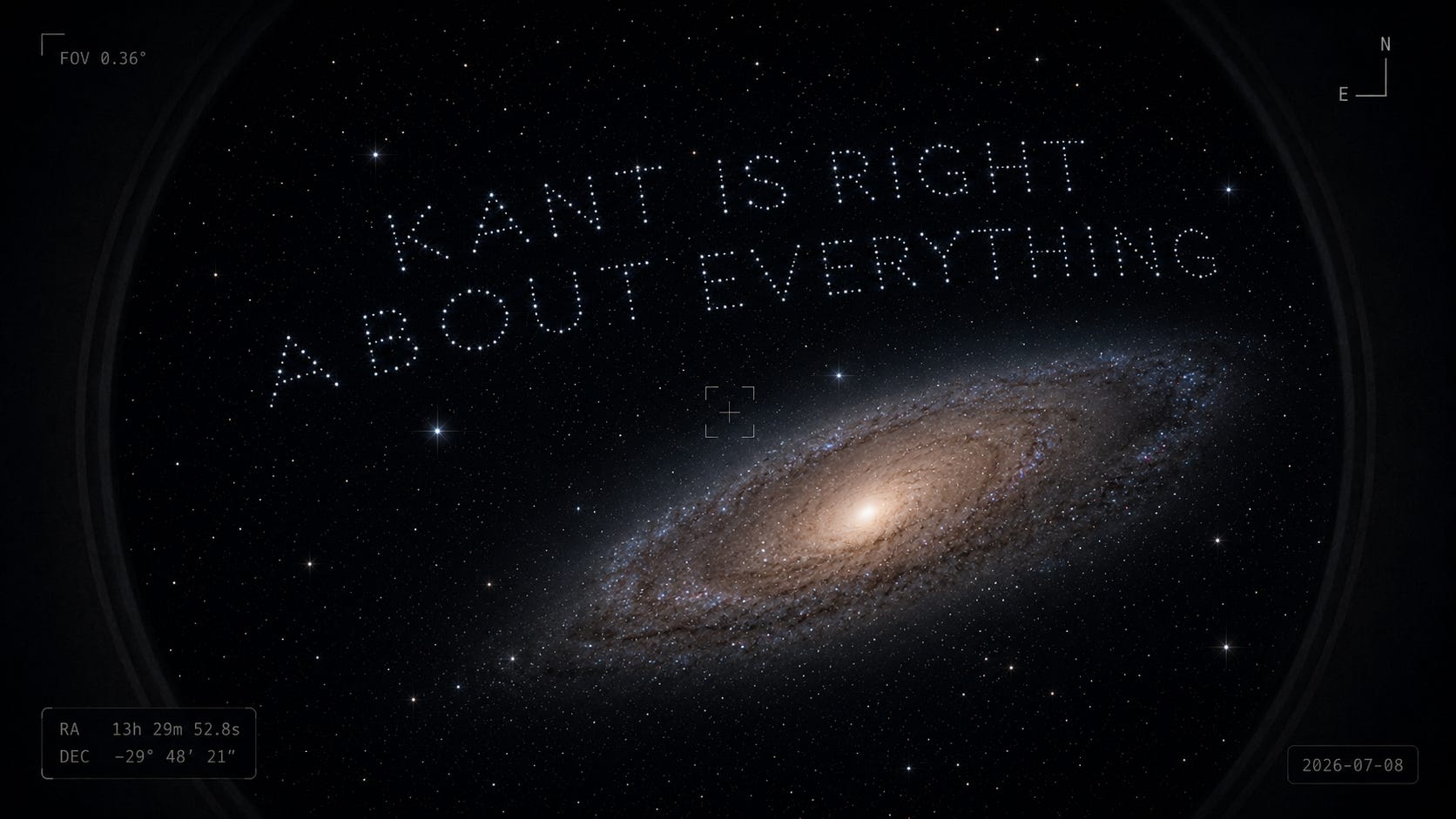
Can we find morality?
The Quran in the Big Bang is possible but practically unreachable. We are never going to read the initial conditions of the universe (at least not for a very long time). Same with the galaxy: we can imagine such evidence, but we can’t go find it. And it feels like a mugging to say, “You must observe all spacetime points to check if Kant is right.”
If the only evidence for objective morality is evidence we can’t get within our lifetimes, the anti-realists win (at least in practice1) and get to rationally act as if moral realism is false. So, can we find any evidence?
The answer is, as always, AI
Just kidding. But not fully.
In “Can AI do philosophy?” Bentham’s Bulldog says that “it is reasonably likely, though not guaranteed, that the world could in principle build AIs that discover the right answers to important moral questions.” I find this reasonably likely, too.
BB gives a few routes: scale up AI cognition, use scalable-oversight-style philosophical grading, try different epistemologies with superintelligences and test their accuracy. All of these sound reasonably possible. Now imagine they agreed on certain moral claims.
Unlike the galaxy, this evidence is something we can visualize happening, mainly because it’s an engineering challenge, not a brute search for “hints” in the sky (I think the former is way more possible than the latter). If different AI-philosophy methods landed on “eating animals is bad,” that’s findable Awesome Evidence. There’s an even weaker version: convergence on what’s not true. Say they didn’t agree on whether deontology is correct, but they all agreed that, say, utilitarianism is false. That’s still some evidence for objective morality.2
Simulation time!
One last counterexample.
As of 2024 we have the entire neural map of an adult fruit fly brain (with 139,255 neurons). Actually fully simulating it isn’t here yet3, but you can imagine we’ll eventually get there.
So here’s the thought experiment. Model an organism’s mind. Scale its cognitive faculties way up (to human-level or higher) and see what moral intuitions it has, if any. “Scale its cognitive faculties up” is doing a lot of heavy lifting in that sentence. I know. Just bear with me for a second.
Now, run the same experiment for a completely different organism like an octopus, whose brain is barely centralized. Repeat for other organisms. Now imagine if we could communicate with them and discovered that they had moral intuitions, or that their intuitions converged. Pretty sci-fi-y, but I think this is theoretically possible.
You can even throw AIs into the mix; they’re practically alien to us, which addresses objections like “um, actually, maybe being carbon-based is what drives the convergence.” (more on this in the next-next paragraph)
In short, if minds that are quite different (in architecture) converged on the same moral intuitions, that convergence would be some evidence for (1) what they converged on, and for (2) there being a moral truth to converge on in the first place (i.e. moral realism!).
Someone can say: this convergence could just be shared bias. If it’s human-AI then it’s the shared human data. If it’s carbon-based convergence then it’s the shared evolutionary byproduct. Or maybe all intelligent beings, regardless of their goals and values, share intuitions about what they “ought” to do because there are some strategies, like cooperation, that increase their survival, which is instrumental to (almost) any goal.
To this I say: maybe. I didn’t say “update to believe the converged statements with total certainty” — you would just update somewhat. And I think it's reasonable to say there is some chance that unpredictable convergence between very different minds is not just shared bias.
Convergence isn’t proof. It just shifts the priors. In other words, you’d expect convergence to be more likely in a world with real moral facts than in one without.
Conclusion
So, to refute “we can never find evidence for objective morality” I present three counterpossibilities that would shift our confidence in that claim:
Stars spelling out a moral claim.
AI super-philosophers, built a few different ways, agreeing on the same ethics.
Minds with different architectures converging on the same moral intuitions.
Therefore, evidence for objective morality is possible, and some of it might even be findable. I do not claim any of the three are likely, only that they could happen and that we could find them (more so the last two than the first). You can probably conjure up other counterpossibilities.
This brings me back to the takeaway from the previous piece: be morally uncertain! And keep searching (via thinking, intuiting, knowledg-seeking, etc.). Who knows, maybe we’ll find the Awesome Evidence for Morality. You shouldn't want your bias for a certain theory to overshadow findings or reduce the updates you need to make in light of Awesome Evidence.
If no possible observation you could make within your lifetime tells you anything about whether moral realism is true, or about specific moral claims, then there is no reason to be “uncertain” or “on the search” for anything.
Convergence on a claim being false is useful because agreeing some moral claim is false is evidence there’s a moral truth at all.
We can simulate a fly brain on a laptop, but only with a rough model of each neuron. A fully realistic simulation isn’t here yet.