When Is Pascal-Wager-esque Reasoning Sound?
Pascal’s argument fails for God, works for moral uncertainty and free will.

The Worst Theological Argument Ever?
Pascal’s Wager, in standard form: believe in God. If He exists, you win infinity. If He doesn’t, you lose nothing (except Sundays, from 10:00 AM to 2:00 PM). Therefore the rational move is to believe.
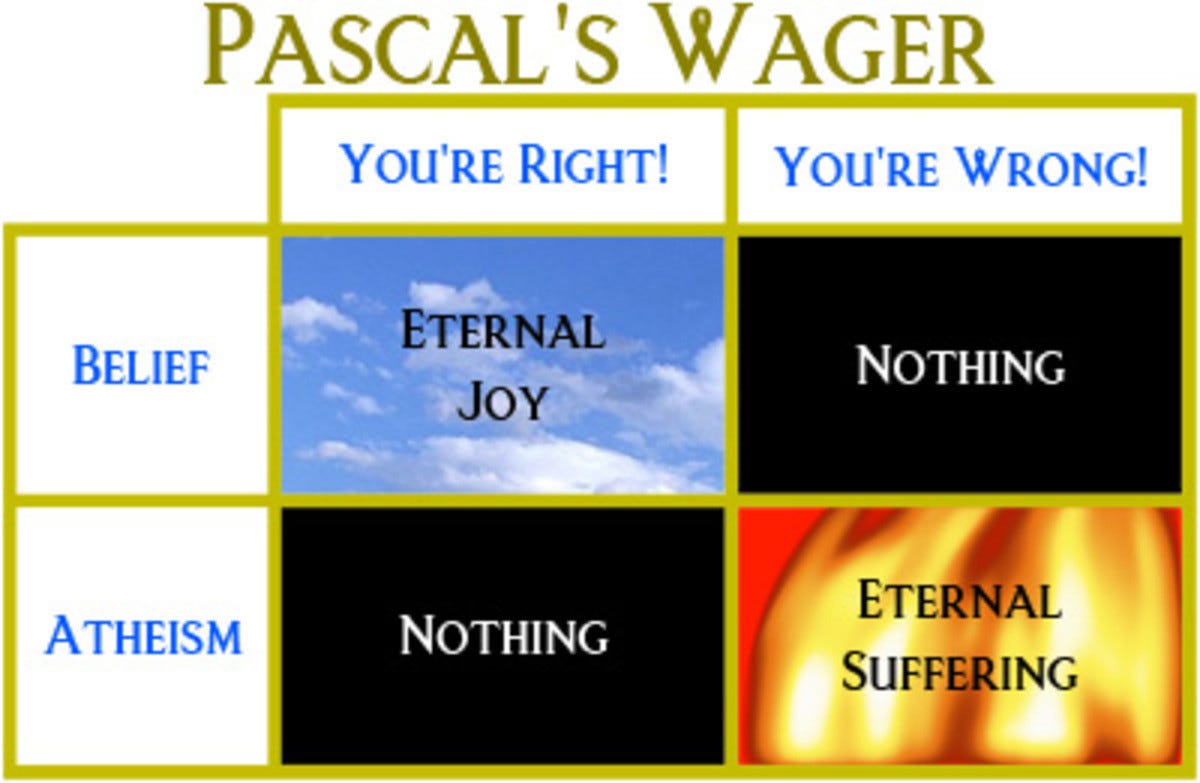
Most of us sense something off when we see this argument. That’s because the argument fails – for specific, nameable reasons that are worth pinning down so we can run other Pascal-esque arguments through the same filters (more of that below).
Pascal’s Wager fails on two counts:
Assumed asymmetry. The matrix presupposes that God rewards belief and punishes disbelief. But why that payoff structure? Maybe God rewards skeptics for using the brain He allegedly gave them. Maybe He’s indifferent. Maybe He punishes believers for cowardice, or everyone because He’s evil.1
Assumed control. The argument tells you to believe. Try, right now, to believe something untestable that you currently don’t believe. Switch your view on, say, whether most people are fundamentally selfish. Belief isn’t a faucet you turn on by deciding to.2
Any argument of the form “act as if X, because if X is true you gain a lot and if X is false you lose nothing” is wrong if it assumes any of these two things. Honestly, just look at this slightly-more-accurate but still-overly-simple wager:

Objective Morality
At the Effective Altruism Northeast Retreat (April 10-12), I was sharing a room with two strangers, doing the standard “hot takes” exchange. One of them said: “Objective morality might exist, so I try to act in accordance with it, rather than assume it doesn’t.”
Pascal alarm. I ran the two filters.
Asymmetry? No… it seems. The conclusion is definitionally tied to whatever the truth is. If objective morality requires doing X, then “acting in accordance with objective morality” means doing X.
Control? Mostly no. The conclusion isn’t “believe in objective morality.” It’s “act as if you do,” and actions are something you control.
So the argument passes both filters. Is it sound? I went to bed thinking, “yes.”
But after a few hours of thinking, I think “not quite.” The structure works, but the conclusion is too vague to be actionable. You don’t know what objective morality is. You don’t know whether morality is obligatory or merely supererogatory3, for example. You don’t know whether morality is true because something says so (God, society, the simulators running our universe) or just true.
The honest update isn’t “act morally” (which morality?); it’s be morally uncertain4. Engage seriously with moral questions, don’t pre-commit to a system, keep the search open. If objective morality exists, you don’t want to miss it by locking in early.
So, does this mean you might as well coinflip every ethical decision? No. There’s one constraint that survives the uncertainty: self-consistency. If objective morality exists, it has to be internally consistent. Which lets you toss out every self-contradictory belief system (e.g. white supremacy, fascism) without needing to know the truth (simply because the truth isn’t in that set).
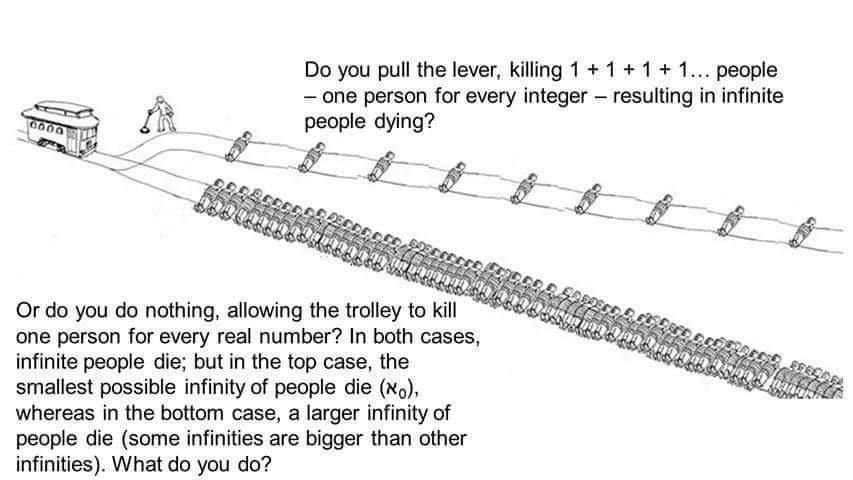
A friend pushed back on this argument, once: “There are infinitely many consistent moral systems and infinitely many inconsistent ones. Your odds of landing on the objective one in the self-consistent set are 1-in-infinity. Both zero. Self-consistency is useless at finding objective morality. QED.”
And they’d be right, if all infinities were equivalent (and if we had a uniform prior over moral systems). They aren’t (and we don’t).
Picture two infinite roads. The first is sand, all the way down. The second has, somewhere on it, a single bottle of Gatorade. Yes, the probability of stumbling onto the bottle on the second road is incredibly small (although possible!). But on the first road, it’s exactly zero (impossible). That distinction seems important. Self-consistency picks the second road; you probably won’t find objective morality, but you’re at least walking somewhere it could be.
(Another way to see how two infinities can differ: would you rather live in hell where you get mildly annoyed by an internet argument every day for eternity, or have your limbs cut off daily for eternity?)
Free Will
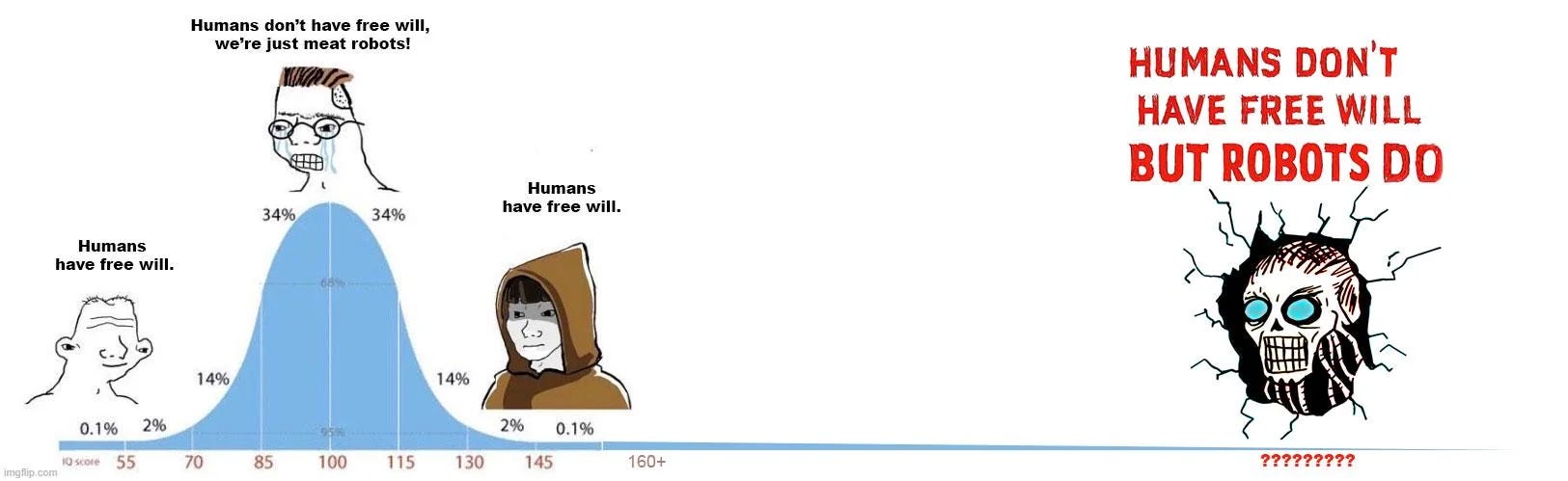
The free will version of the wager: act as if you have free will. If you do, you get agency. If you don’t, then your “choice” to act as if you do wasn’t really a choice, anyway.
This argument is a little different from the morality one; it has a meta property. One column of the matrix (no free will) is empty: there’s no error to make in a branch where you can’t choose! The deliberation only matters in the branch where free will exists, and in that branch, acting as if it does is, therefore, correct.
Asymmetry? Not assumed. The “no free will” column is empty by definition.
Control? Yes, in the only branch that matters.
This might be the cleanest case of Pascal-shaped reasoning that actually works. It survives both filters trivially. I find it very convincing, and I can’t tell whether that’s because it’s correct or because I had no choice (haha, get it?).
Universalism?
A friend of mine, Rishi, takes the wager-shape one step further, and calls it Universalism: we don’t (yet) know the purpose of the universe, but we know how to find out — by acquiring knowledge. So the moral imperative is to maximize knowledge. If objective purpose exists, knowledge is the path to it. If it doesn’t, then it didn’t matter what we optimized for anyway.
Same meta-property as the free will argument. One column of the matrix (no objective purpose) is structurally vacuous. In the only column that matters, knowledge-acquisition is the path.
Asymmetry? Structural, like free will. Control? Yes, we can do science, build telescopes, train AI (and as Rishi recommends, pursue the Hive Mind?).
This seems to render most human-centric actions amoral (or immoral, counterfactually5). But some remain. Extinction mitigation, for example, doesn’t go away, cause you can’t knowledge-maxx if everyone’s dead.
I’m not fully convinced that knowledge is the bottleneck for finding objective morality. Maybe it’s experience. Maybe it’s lots and lots of dialogue. Maybe it’s something we don’t have a name for yet. But the main idea is right: until we find objective morality, our best bet is to be self-consistent, mitigate extinction, and try to find morality (perhaps through knowledge, perhaps experience, perhaps something else).
Pascal Walked So We Could Run
So when is Pascal-Wager-esque reasoning sound? Two conditions:
The asymmetry isn’t smuggled in. Either the payoff structure is definitionally self-contained (morality: do whatever the truth turns out to be), or one branch is structurally vacuous (free will, Universalism).
The conclusion is about action, not belief. “Act as if X” is doable. “Believe X” isn’t, at least not on demand.
Pascal’s original argument fails. The asymmetry is smuggled (why does God reward belief specifically, and not skepticism, or kindness, or being good at Tetris?), and the conclusion demands a belief flip you can’t pull off (at least without joining a cult).
But the structure isn’t the problem. The structure is useful elsewhere (moral uncertainty, free will).
You can invoke “God must be good” arguments and, therefore, wouldn’t punish belief. But it’s unclear how omnibenevolence forces an asymmetric payoff conditional on belief in particular (rather than anything else).
You can technically change your beliefs by joining a sufficiently effective cult and/or undergoing the right brainwashing. So the control assumption isn’t exactly impossible, but even under the best plan for self-brainwashing, you might fail.
As in, morally good but not required, like donating a kidney to a stranger.
For more on this, see Moral Uncertainty (2020) by MacAskill, Bykvist, and Ord.
Resources spent on, say, individual welfare could have gone toward knowledge-maxxing instead. So the foregone knowledge gain becomes a moral cost.
Why does objective morality have to be self-consistent?